The Eichrecht chain ✅
How emob verifies OCMF signed meter values under German Eichrecht (MessEG §33): key registry, chain checks, energy vs duration, and the transparency file.
German calibration law (Eichrecht) lets a charging operator bill a
kilowatt-hour only if the customer can verify the measured value against a
conformity-assessed meter, long after the session [MessEG §33],
[PTB-A 50.7], [REA 6-A]. In practice the meter signs each reading in
OCMF — the Open Charge Metering Format — and the operator must check those
signatures, bind them to the right station, confirm nothing is missing, and hand
the driver a file they can check themselves. emob-eichrecht does all of that.
A value that does not verify does not bill
This is enforced by the type system, not by convention.
Evidence::billable_energy() is the only way to obtain a billable quantity, and
it returns None whenever any check failed. Billing anyway requires code that
visibly ignores the answer.
let evidence = Evidence::assemble(&records, ®istry, session_start);
match evidence.billable_energy() {
Some(energy) => println!("bill {energy}"),
None => for reason in evidence.reasons() { eprintln!("blocked: {reason}") },
}
Each gate between the station’s records and the invoice can refuse on its own:
flowchart LR
    RAW["OCMF records<br/>from the station"] --> P["parse<br/>signed bytes kept verbatim"]
    P --> V["verify<br/>ECDSA, ocmf"]
    KR[("key registry<br/>out of band")] -.->|the key, never<br/>the record's own| V
    V --> C["chain<br/>pagination, markers, states"]
    C --> E["evidence"]
    E --> Q{"billable?"}
    Q -->|yes| BILL["energy · duration<br/>each answered separately"]
    Q -->|no| WHY["reasons<br/>naming what failed"]
    E --> TX["transparency file<br/>the driver's own verifier"]

    classDef gate fill:#b8410f22,stroke:#b8410f
    classDef out fill:#0a7d3322,stroke:#0a7d33
    class P,V,C gate
    class BILL,TX out
Anyone can check a single signed value without emob or a receipt: the verifier runs the receipt’s own WebAssembly module in the browser and uploads nothing.
The transparency file comes from the evidence, not from a successful outcome: a disputed session that did not bill is exactly when the driver needs to check it. In the running estate, the driver’s receipt for a refused session says so first, with the paragraph and the finding:
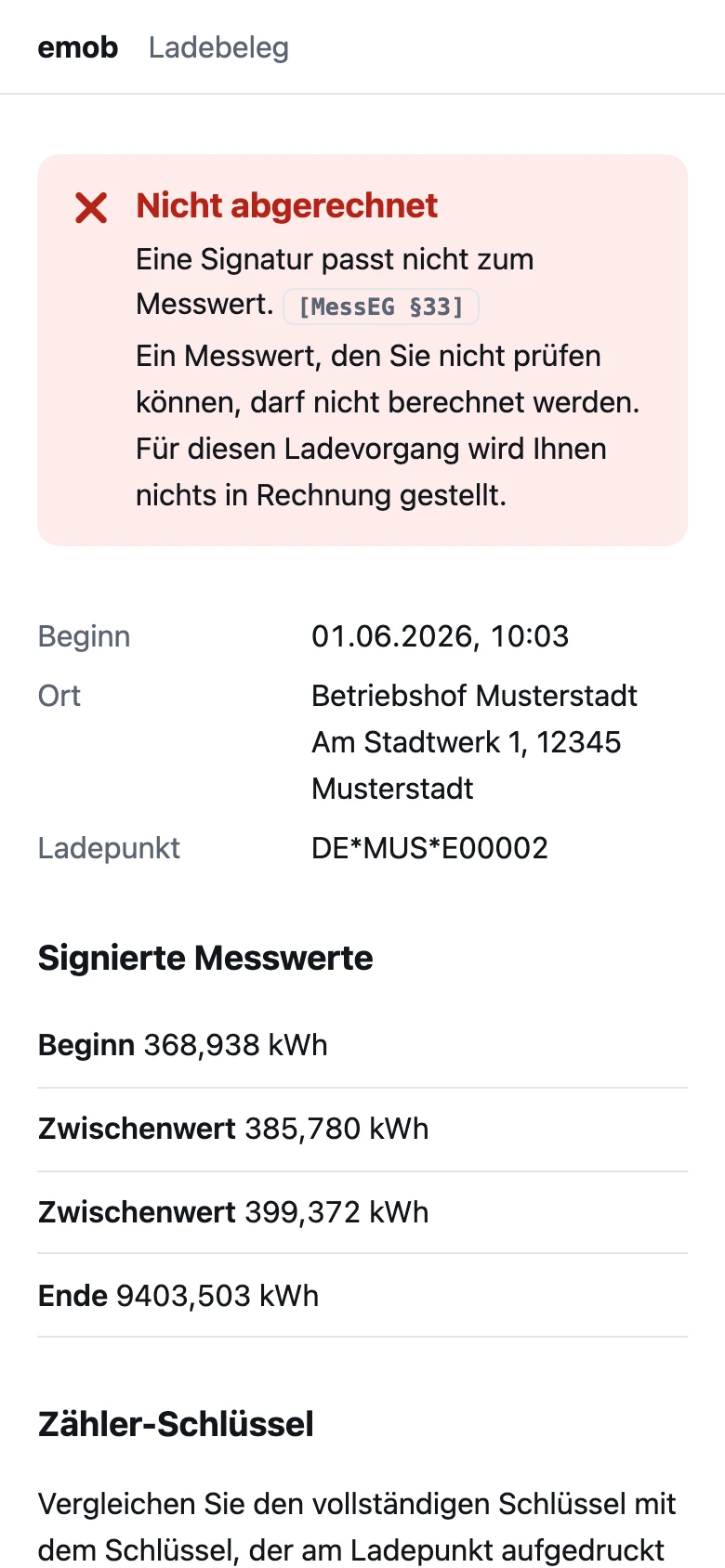
Each refusal is also available as a typed finding — Evidence::findings gives
the kind of fault, what it disqualifies and the paragraph it rests on (for
example a signature mismatch under [MessEG §33]) — which the operator page
shows under “Warum?”. Next steps for a verified quantity are covered in
Sessions and settlement and
Tariffs.
The checks, and who owns each
Parsing and verifying OCMF belongs to the ocmf
crate. Deciding what a failure costs — which is a question of law — belongs to
emob-eichrecht. As ocmf itself puts it, “whether a session may be invoiced
depends on tariffs, on a key registry binding each record to this charge point,
and on law — none of which is in scope”.
| Question | Answered by | Whose | Skipping it means |
|---|---|---|---|
| Did this key produce these bytes? | ocmf::verify | the format’s | anyone can bill you |
| Are any records missing? | ocmf::session | the format’s | a session with a hole in it bills |
| Is this key this charge point’s key? | KeyRegistry | ours | the record vouches for itself |
| Which quantity does each failure take away? | chain::validate | ours | one boolean throws away what the format kept apart |
| Are the two ends the same quantity? | the OBIS code and the unit | ours | kWh minus Wh, off by a thousand |
| May these readings be billed? | MeterState, error flags | both | a substitute value becomes an invoice |
| May the duration be billed too? | TimeStatus, the t flag | both | an occupancy fee is billed off an unsynchronised clock |
| Which way did the energy go? | the OBIS code | both | a V2G discharge is billed as consumption |
| …and did only one direction move? | the OBIS codes of every register | ours | the other half of a V2G session vanishes with no finding |
| Who was charging, and did it hold? | IdentificationLevel | both | a rejected certificate becomes a customer |
| Can the customer repeat all of it? | transparency::to_xml | both | the law’s actual requirement is unmet |
How OCMF records are parsed: signed bytes stay verbatim
The signature covers the payload exactly as written:
Between signing and validation, the payload section must not be manipulated (removing and adding white spaces), otherwise positive validation is not possible.
The ocmf parser preserves the original payload. Calling record.signed_bytes()
returns a slice of the input. It is tested against the whole S.A.F.E. Transparenzsoftware reference
corpus (256 records from eleven manufacturers, 705 readings) with OpenSSL’s
verdict on each as an independent oracle, plus a 162-case conformance suite.
The corpus shows why a parser written from the specification alone fails:
| Measured | Count | What a parser built from the tables does |
|---|---|---|
Records omitting MS, which [OCMF Tab. 3] marks 1..1 | 229 / 256 | strict cardinality rejects nine real records in ten |
Readings omitting TM, relying on carry-forward | 205 / 705 | a reading read independently of its neighbours is wrong |
Readings writing RV as a JSON string | 23 | a typed deserialiser refuses them |
| Records whose payload is pretty-printed | 9 | any re-serialisation destroys the signature |
OBIS codes written the way [OCMF Tab. 25] specifies | 0 | a canonical-form check refuses every record ever sent |
Deviations are reported, never swallowed: each becomes a typed finding naming the value and the table it departs from. A strict parser would make lawful sessions unbillable; a silent lenient one would hide that a fleet emits records the official tool rejects.
Two more parsing rules matter for money:
- Numbers keep their scale.
2935.600 kWhstates three decimals of meter resolution; routing it throughf64turns it into2935.6.reading.value().as_str()returns"2935.600". - An omitted field is unchanged, not absent. Within a record, readings omit
fields identical to the previous reading
[OCMF Tab. 7 preamble].RU,RT,STandEFcarry forward; reading an omittedEF(error flags) as “no fault” would clear something the station signed.
Why a valid signature is not enough
Signatures cannot see a deleted record
Each record is signed independently, so deleting the middle of a session leaves
every remaining signature valid. The chain check catches it: pagination must be
contiguous, the first record must open the transaction (TX=B), the last must
close it, and nothing may be added in between.
// Every signature genuine; the session still does not bill.
let report = chain::validate(&[record_pg1_begin, record_pg3_end]);
assert!(report.findings.iter().any(|f| matches!(
    f,
    ChainFinding::Sequence(Finding::PaginationBroken { from: 1, to: 3, .. })
)));
assert!(!report.is_billable());
ChainFinding::Sequence wraps what ocmf found; disqualifies says what it
costs. The chain also requires one signing component throughout
[OCMF §Relation of Serial Numbers], anchored on the first record that names
one, and rejects pagination written as both T007 and T7.
The key comes from outside the record
A verifier that reads the public key from the record it checks has verified
nothing. OCMF requires the key to arrive “by means other than this protocol
(out-of-band)”. KeyRegistry is filled from type approval documents or a
provisioning system, and identifies the signer by meter serial, gateway serial,
or both when one gateway serves several meters.
Keys carry half-open validity windows [from, until), so a meter exchange
does not make past sessions unverifiable and no instant is covered by two keys:
registry.key_at(&component, datetime!(2026-01-15 12:00 UTC));  // the original key
registry.key_at(&component, datetime!(2026-09-15 12:00 UTC));  // the one after the swap
insert refuses a window that overlaps an existing one for that component, and
an empty window (until <= from) that would register cleanly and verify
nothing. A gap between windows stays a gap: a record from an uncovered period
fails rather than borrowing a neighbouring key.
Meter state and error flags
ST=S means the meter substituted a value because it could not measure one —
valid telemetry, never a basis for an invoice. Only ST=G bills. An unknown
ST code, or an unrecognised EF error-flag character, blocks billing, so a
future OCMF revision cannot widen what gets invoiced.
Energy, duration, identity and direction are separate answers
OCMF keeps four facts apart, and so does the evidence: EF flags energy (E)
and time (t) separately [OCMF Tab. 7], TM says how far the clock can be
trusted [OCMF Tab. 19], IL says how the user was identified
[OCMF Tab. 11], and the OBIS code says which way the energy went
[OCMF Tab. 25].
// The same session, clock status `U` — unsynchronised.
assert_eq!(report.billable_energy.unwrap().to_string(), "29.500 kWh");
assert!(!report.is_billable_for_time());
An unsynchronised clock leaves good energy and an indefensible duration, so a
per-kWh price bills and the per-minute occupancy fee [AFIR Art. 5(4)] allows
must not. emob-cdr enforces this too, refusing a per-minute tariff on such
evidence and naming the fix. A register from the range [OCMF Tab. 25] reserves
but does not define (B4–BF, C4–C7) is the opposite case: it takes the
energy and leaves the clock.
ChainFinding::disqualifies() names which quantity each finding removes, and a
test asserts every finding removes at least one. To explain a dispute about one
quantity, ask for just its reasons:
evidence.reasons_for(Disqualifies::Duration);   // the clock
evidence.reasons_for(Disqualifies::Energy);     // empty — the register held up
User identification
IL values MISMATCH, INVALID, OUTDATED and UNKNOWN mean the
identification failed — energy was measured but nobody is provably behind it —
so they block billing. They are kept off the ordered strength scale, so no
>= comparison can treat a rejected certificate as merely weak. The strength
that is on the scale (HEARSAY to SECURE) is taken as the weakest any record
asserted and passed to the CDR’s cross-check.
Energy direction and V2G
[OCMF Tab. 25] assigns OBIS codes B0–B3 to import and C0–C3 to export:
assert_eq!(ObisCode::new("01-00:C2.08.00*FF").direction(), Some(Direction::Export));
A record claiming a draw over an export register is a V2G discharge billed as
consumption; emob-cdr and the partner pre-flight both refuse it. A code that
cannot be classified states no direction rather than defaulting to import. A
chain in which both an import and an export register moved bills neither —
otherwise one direction would vanish without a finding. A bidirectional meter
whose export register stood still is fine.
Units must match at both ends
RU (the unit) carries forward only within a record [OCMF Tab. 7], so a chain
can open at 2935.600 kWh and close at 2965100 Wh with valid signatures. That
is refused, not converted — a conforming meter does not change units mid-session,
and silently repairing it would put an unreproducible number on an invoice
[MessEG §33]:
let report = chain::validate(&[opens_in_kwh, closes_in_wh]);
assert_eq!(report.billable_energy, None);
assert!(report.billable_duration.is_some()); // the clock is unaffected
Cable-loss compensation
CL reports cable-loss compensation already included in RV. It is valid
“only when RI is indicating an accumulation register reading” and resets at
TX=B [OCMF Tab. 7, CL]. emob checks the OBIS D group (8 = time integral,
so 1.8.0 accumulates and 1.7.0 does not), reads CL on the register chosen
for billing, and returns it as an Energy in the register’s unit — so 420 Wh
never reads as 420 kWh. The loss is never subtracted; it travels on the CDR, and
the OCPI crossing states it in a note, because [REA 6-A §3.2] makes telling the
customer what is inside a measured value a duty.
Transaction markers
TX=X— “error during charging … time and/or energy are no longer usable from this reading (incl.)”: nothing is billed across it.- Two
TX=Bmarkers mean two sessions were concatenated; pagination stays contiguous across the join, so only this check sees it. TX=S(suspended, not charging) andTX=T(tariff change) are signed facts about the session’s shape.evidence.suspended_intervals()returns them, andemob-ocppcompares them with OCPP’s unsignedchargingState— as a note, never a refusal, sinceSis optional.
The transparency file for the S.A.F.E. verifier
[MessEG §33] requires that the affected party can check a measured value,
not merely that it is correct. In Germany the check is done with the S.A.F.E.
Transparenzsoftware, an independent verifier, which reads an XML container:
<values>
  <value transactionId="120" context="Transaction.Begin">
    <publicKey encoding="hex">3059301306072A8648CE3D…</publicKey>
    <signedData format="OCMF" encoding="plain">OCMF|{…}|{"SD":"…"}</signedData>
  </value>
  <value transactionId="120" context="Transaction.End">…</value>
</values>
let xml = transparency::to_xml(&evidence)?; // hand this to the driver
- Each record appears verbatim, beside the key from the registry — never a
key chosen later to make the file verify. The export takes an
Evidence, not loose keys, for that reason. - The key element comes first, as the verifier’s own
values.xsdrequires. - A record that did not verify has no
<value>;reasons()explains why. transactionIdis one id per transaction, since the verifier groups by it to pair begin and end. The grouping comes fromocmf::xml, which matches how S.A.F.E.’s 257 reference values are grouped — including the 223 that carry begin and end in one record and therefore have notransactionId.
When a driver sends a file back, read it with transparency::from_xml. The key
inside is a claim by the file, not the key: compare it with your registry —
a different key is a dispute with an answer. The reader is strict (no comments,
CDATA, namespaces or unknown entities), because a verifier that accepts what it
half-understands defeats its purpose.
The driver receipt: three checks a driver can make
Every session csmsd settles or refuses has a receipt page at
<public_url>/r/<token>. It gives the driver three independent ways to check
the value:
- The meter key, in groups of four, to compare with the label on the charge point.
- The transparency file above, for the S.A.F.E. Transparenzsoftware.
- Selbst prüfen — a WebAssembly build of the same
ocmfverification, which checks every signed value on the phone, offline once loaded. On the command line,emob verify <file>runs the same function.

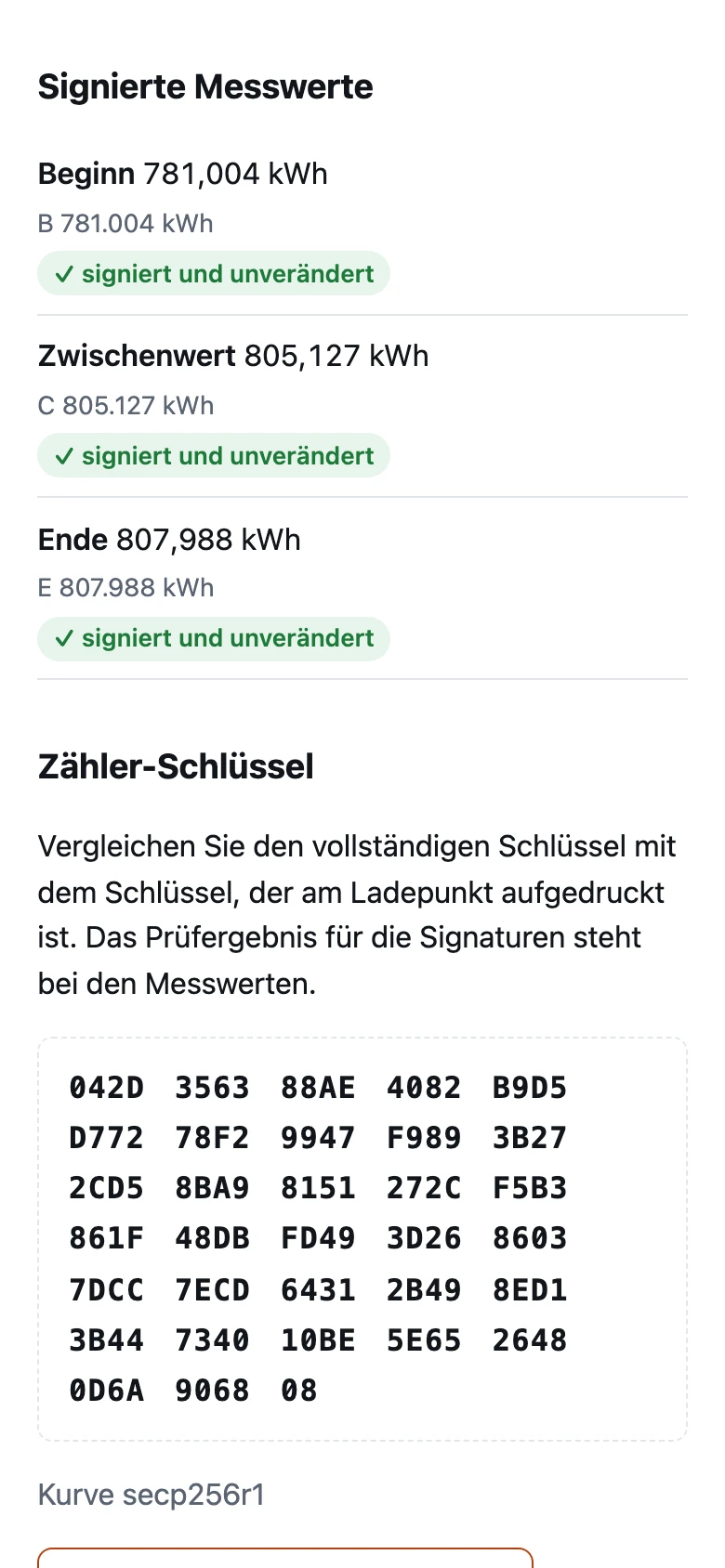
The verifier’s verdict equals OpenSSL’s and emob-eichrecht’s on all 256
records of the S.A.F.E. reference corpus. The page shows no contract id and no
card number. See Run the estate.
Tested against real meters
Self-signed fixtures only prove the code agrees with itself, so the suite also runs records from five third-party devices, each against its published key:
| Record | What only a real meter produces |
|---|---|
| eBZ LD3 (secp192r1) | a curve the default toolbox does not carry, and a non-canonical DER signature |
| DZG DVH4013 / Nano (secp256k1) | a signature with s in the high half of the curve order, which some libraries reject but plain ECDSA allows |
| DZG + TwinCharger Pro | RV written as a quoted string, padded with spaces |
| TwinCharger Pro | FV and CT written as numbers where the tables say String |
| DZG GSH01.1K2L | the Open Charge Alliance’s own StopTransaction.req example |
// an eBZ LD3 from the S.A.F.E. reference data set
assert_eq!(evidence.billable_energy().unwrap().to_string(), "0.268 kWh");
assert!(!evidence.is_billable_for_time());   // its clock is only informative
A rejected high-s signature would report tampering on a meter that did
nothing wrong, for every session it signs.
Signature curves and DER encoding
[OCMF Tab. 22] names seven algorithms. Four verify in pure Rust —
secp256r1 (the default since OCMF 0.4), secp384r1, secp256k1 and secp192r1. The
other three are refused by name, so an operator learns what the fleet needs
instead of seeing a signature mismatch. ocmf can verify them through OpenSSL,
but a sans-I/O domain crate cannot link a C library that opens files; a daemon
may do so and pass in the verdict. secp192r1 is supported because ordinary
German hardware (the eBZ LD3) signs with it.
Meters do not always emit canonical DER: the eBZ firmware pads r and s to a
fixed 24 bytes regardless of sign. emob reads each integer as an unsigned
magnitude and re-encodes it minimally before verifying — lenient about
encoding, strict about structure. Because OCMF pairs SHA-256 with every
curve, verification uses the prehash path, which handles digests shorter or
longer than the curve’s field.
Rectifier losses on DC stations metered on the AC side
[REA 6-A §3.2] lets a DC station meter on the AC side, before the rectifier,
so the rectification loss is inside the billed value — on three conditions:
- the station was placed on the market before 2018 and is rated at most 50 kW (AFIR’s fast-charger duties begin at 50 kW; this allowance still applies at 50 kW);
- the rectification “kann einem einzelnen Ladevorgang ausschließlich und eindeutig zugeordnet werden” — a multi-outlet cabinet sharing one rectifier does not qualify;
- the customer is told: “Die von einem Messwert oder einer Rechnung Betroffenen sind in geeigneter Weise darauf hinzuweisen, dass die … Energie für die Gleichrichtung … Bestandteil des angegebenen Messwerts ist.”
The third condition names both the measured value and the invoice. Where the
evidence states a compensated loss [OCMF Tab. 7, CL], emob-billing puts the
figure and the notice on the invoice line (BT-127, the EN 16931 line note). The
notice at the charge point is a profile field, rectification_loss_disclosed.
“Placed on the market” is not commissioning; where it is unknown, the profile
falls back to the later commissioning date, so the exemption fails rather than
being granted on an unstated date.
Durations shorter than the clock can resolve
[REA 6-A §3.1] caps the shortest time span a station’s clock must measure
accurately at 60 seconds, and says values below that span are not used for
billing. ClockResolution defaults to that cap; a station whose manufacturer
states a better figure can say so.
The two clock rules are handled differently on purpose. A clock that cannot be
placed in time vouches for no duration, so a time-based tariff is refused. A
span below the resolution is one unusable value, so the rating drops only that
line with RatingNote::DurationBelowResolution, and the energy still bills —
otherwise the common 30-second EVConnected wait before charging starts would
make ordinary sessions unbillable.
The operator’s other Eichrecht duties
Verifying records is not the whole law. Duties on whoever uses the meter
[MessEG §31(2)] and whoever uses its values [MessEG §33(2)] are facts
about the operation, not the records, so they live in the
obligation calendar:
- Verification period.
[MessEG §37(1)]forbids using a meter after its Eichfrist. It starts at placing on the market[MessEG §37(1) S. 2], runs eight years for charging equipment[MessEV Anl. 7 Nr. 6.7], and ends at the end of that calendar year[MessEV §34(2)]— so a meter placed in March 2018 may be used until 31 December 2026. - Interventions.
[MessEG §31(2) Nr. 4]requires a record of every maintenance, repair or electronic measure on the meter — including firmware pushes from the CSMS. - Confirmation from the meter operator.
[MessEG §33(2)]requires a provider billing on someone else’s meter, as in roaming, to obtain confirmation that the meter’s operator meets its duties — a clause in the roaming agreement.
Limits
Retention periods per artefact: MessEV and PTB give them but the reading is not settled, so nothing here expires an artefact.
Related: Getting started · The OCPP seam · The obligation calendar